

SHARE:
The Most Bizarre (and Beautiful) Endemic Species!
When tectonic drift rives landmasses apart, or extreme and unusual environmental conditions arise in selective ecosystems, evolution finds the perfect opportunity to conduct an experiment – what adaptations must life make to survive?
The answer to this existential question can arrive in the form of absurd whimsy all the way to downright fear factor. This is the world of endemic species – creatures so finely tuned to their surroundings that their entire existence is confined to a single region. Whether an island, a rainforest, or an arid desert, these species must develop extraordinary adaptations – some are masters of deception, others sport outlandish colours, exaggerated features, or peculiar behaviours.
However, such exclusivity comes at a price: to be endemic is to be vulnerable. Some of these species are exceedingly rare, threatened by habitat loss, climate change, or human intervention. Thus, we should remain mindful of the efforts to preserve these extraordinary creatures, lest they go the way of the Dodo. Read on to be acquainted with some of the most bizarre and beautiful endemic species in the world!

Thorny devil
It’s long been known that Australia is replete with wildlife that wants to kill you, from shiver-inducing funnel-web spiders, bodybuilder kangaroos, and snappy crocodiles – at first glance, the thorny devil is yet another on the long roster. Luckily, the reptile in question is harmless to humans, and feeds exclusively on ants.
Covered in sharp, spiky scales, with a “false head” on its back to confuse predators, this reptile sports an undeniably fearsome look. As always, there is however, a method to its madness. Its spines serve a dual purpose: deterring predators and helping it collect water by funnelling moisture from any part of its body toward its mouth
It’s also particularly well-camouflaged, changing colour depending on the time of day and temperature, shifting from pale yellow or sandy brown in hot conditions to darker shades when it’s cooler.

Satanic Leaf-Tailed Gecko
Endemic to the dense rainforests of Madagascar, the Satanic leaf-tailed gecko is rightfully deserving of its ominous moniker: this reptile is deftly designed to resemble a leaf – in fact, they were so thorough in evolving this appearance that some develop holes in their tails and jagged edges to appear like decomposing leaves. Some individuals even have horns above their (typically) red eyes – fully confirming their association with Lucifer himself.
This species is an ambush predator, remaining motionless for hours, waiting for unsuspecting insects to come within striking range. Their large, lidless eyes are adapted for low-light vision. When threatened, they open their mouths wide to reveal a vivid red interior while hissing loudly.
In order to further evade detection, they even have the ability to ‘erase their shadow’ – by flattening their bodies against tree bark and adjusting their posture, they can prevent a shadow forming and become almost impossible to spot. Even field researchers report them impossible to distinguish when they’re looking directly at one!
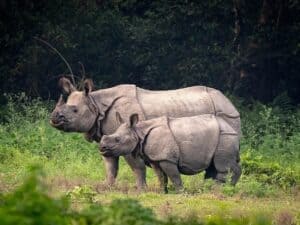
Javan rhino
One of the rarest and most elusive large mammals on Earth, The Javan rhino is one of the remaining vestiges of a time when rhinoceroses roamed vast stretches of Asia – this graphic illustrates the unfortunate habitat loss of this once ubiquitous species. Unlike its more famous African relatives, this species is a solitary, forest-dwelling creature, now confined to a single location: Ujung Kulon National Park in Indonesia.
Unlike the bulky, armoured appearance of the Indian rhino, the Javan rhino has a more subtle, mosaic-like skin texture. It sports a single, modestly sized horn, usually less than 25 cm long. Though in females, it is often entirely absent. Unlike other rhinos that rely on their horns for defence or dominance, the Javan rhino’s more secretive nature means it rarely needs to fight, preferring to vanish into the dense rainforest when disturbed. So elusive are Javan rhinos that no scientist has ever studied a wild one up close – almost everything we know about them comes from hidden cameras and footprint tracking.
The Javan rhino is now critically endangered with fewer than 80 remaining. Since the entire population exists in a single park, a natural disaster such as a tsunami or volcanic eruption from nearby Krakatoa could wipe out the species entirely. Despite decades of protection, their numbers remain precariously low.
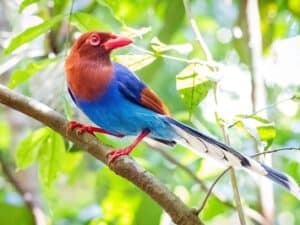
Sri Lanka blue magpie
Unlike most magpies, which are muted in colour, the Sri Lankan blue magpie is preternaturally colourful, sporting bright blue plumage, a chestnut-red head and wings, and striking red beak, legs, and eye-rings, making it one of the most visually stunning members of the crow family.
Sociable and highly intelligent, these birds often move in small, noisy flocks, communicating through a series of loud, chattering calls. They’re also known to mimic other species, making them some of the most expressive and beguiling birds in Sri Lanka’s forests.
Unfortunately, deforestation poses a severe threat to their survival. As Sri Lanka’s rainforests continue to be cleared for agriculture and development, their populations are declining, leading to their classification as Vulnerable on the IUCN Red List. Conservation efforts, including the protection of remaining rainforests, are crucial to preventing their eradication.
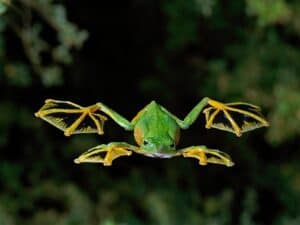
Wallace’s flying frog
Named after the famed naturalist Alfred Russel Wallace, Wallace’s flying frog defies conventional expectations of amphibians by gliding through the air with its massive, webbed feet. Endemic to Indonesia and typically found in the rainforests of Borneo, its feet act like parachutes, allowing it to soar up to 15 metres between trees in search of food, mates, or to evade predators.
Its bright green body, striking yellow sides, and jet-black webbing give it a bold, almost theatrical appearance, making it one of the most visually striking tree frogs in existence. It spends most of its life in the forest canopy, rarely descending to the ground except for breeding. During the mating season, it constructs foamy nests on leaves above water sources, ensuring that when the tadpoles hatch, they drop safely into ponds or streams below.
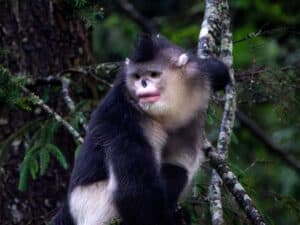
Yunnan snub-nosed monkey
With a plump pair of lips that would give a reality TV star a run for their money, the Yunnan snub-nosed monkey certainly boasts a striking appearance. Found in the remote, high-altitude forests of Yunnan and Tibet, China, it is one of the most cold-adapted monkeys in the world, thriving in snowy mountain landscapes at elevations of 3,000 to 4,500 metres, where temperatures can plummet to -20°C.
Characterised by its pale blue face, upturned nose, and thick, shaggy fur, this species is built for survival in extreme conditions. Unlike most monkeys that rely on fruit, it has adapted to a diet of lichen, scraping it from tree bark during the harsh winter months when other food sources are scarce. This unique dietary specialisation allows it to persist in an environment that few primates could tolerate.
Highly social and intelligent, Yunnan snub-nosed monkeys live in large troops of up to 600 individuals, making them one of the most group-oriented primates. Their society is structured into smaller family units within the larger group, and they are known for their strong social bonds and cooperative behaviours.
While most of these species require a keen eye and an intrepid bent to spot, there are certainly opportunities for the keen explorer. If you’re interested in an encounter or simply want to learn more about the locations, visit our destination pages (peppered throughout this article), or contact us directly: enquiries@odyssey-world.co.uk / +44 117 313 7070!
+Endemic+Species!)