
SHARE:
Astonishingly Alien Landscapes on Earth!
Most terrestrial locations possess a familiar combination of ingredients: while oftentimes strikingly beautiful, it’s not uncommon to be acquainted with tall trees, verdant rolling hills, sandy beaches and even the occasional dune.
However, there are landscapes where time, geology, and climate have conspired to create a scene so disorientingly otherworldly that it may be easy to forget exactly which planet you’re on! From bewildering salt flats, vivid shimmering lakes, and lunar-esque wastelands, there are still a plethora of Earth-based locations that can appear confoundingly cosmic.
It’s no coincidence that NASA test Mars rovers in some of these extreme locations, nor that astrobiologists scour their soil for clues about life in the universe. In fact, some of our clients have visited these locations and wax lyrical about their striking nature – so, keep scrolling and you can discover some of the world’s most astonishingly alien landscapes!

Valley of the Moon (Chile)
The Valley of the Moon in Chile is a landscape so unearthly it feels like a set piece for a sci-fi epic. Located in the already striking Atacama Desert, one of the driest places on Earth, this barren expanse is sculpted by millennia of wind and water erosion, leaving behind jagged salt formations, undulating sand dunes, and craggy rock faces that glow red at sunset.
Its resemblance to the lunar surface is uncanny, hence the name. But under certain conditions, it could just as easily pass as Mars. The cracked earth, salt flats, and eerie silence make it one of the most extreme, lifeless places on the planet. NASA has even used the region to test Mars rovers, and astrobiologists study its soil for insights into life in extreme environments.

Makgadikgadi (Botswana)
The Makgadikgadi Salt Pans in Botswana are the remnants of an ancient superlake, now a vast, blindingly white expanse that stretches to the horizon like a scene from an uninhabitable planet.
Thousands of years ago, this region was submerged beneath the massive Lake Makgadikgadi – a prehistoric lake that would’ve been considered one of the largest in the world by today’s standards. Over time, shifting climate patterns caused the lake to evaporate, leaving behind a parched, crusted desert of salt and clay. Today, it is a seemingly endless expanse, where the sky and ground blend hypnotically.
However, after rare, heavy rains, the pans can transform into shallow, reflective lakes that draw in flamingos by the thousands.
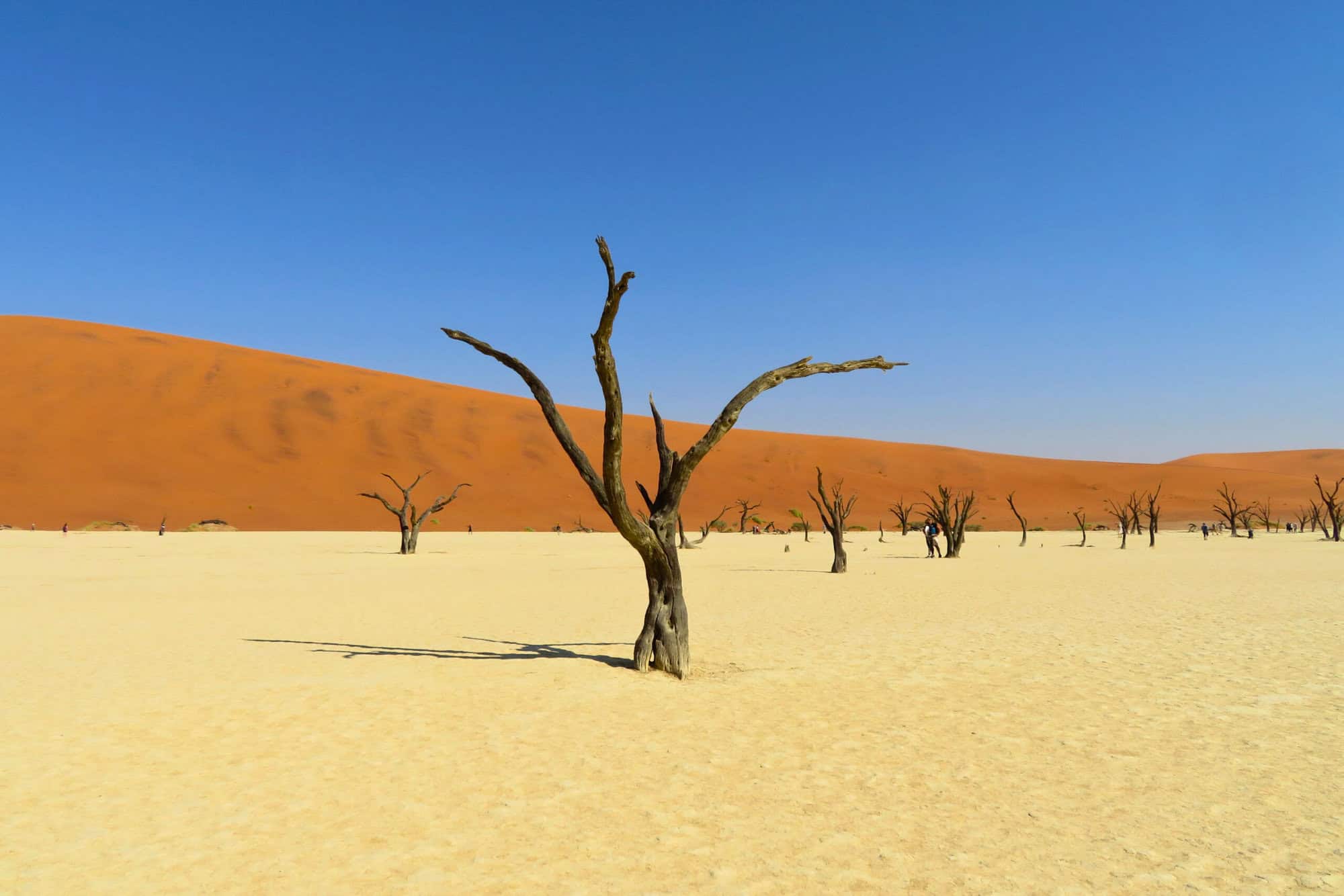
Dead Vlei (Namibia)
A place that time seems to have forgotten – Dead Vlei in Namibia has a fascinating story to tell: once a thriving oasis, this area was once filled with life, including the (now perished) camel thorn trees. However, over time, shifting sand dunes blocked the river’s flow, starving the lake’s water supply and leaving an arid, scorched, and dead basin (hence the name).
The reason the trees remain, rather than decomposing, is due to the region’s extreme aridity. The Namib Desert is one of the driest places on Earth, and Dead Vlei receives almost no rainfall. Without moisture, the bacteria and fungi responsible for decomposition are virtually nonexistent. Instead of rotting away, the trees slowly desiccated – their wood became hardened and essentially mummified due to the relentless desert heat.
Namibia is one of our favourite destinations (and the birthplace of our Africa expert Madri). Many of our clients have had extraordinary encounters with this otherworldly location – if you’re interested in such an excursion, visit our Namibia destination page to peruse itineraries!
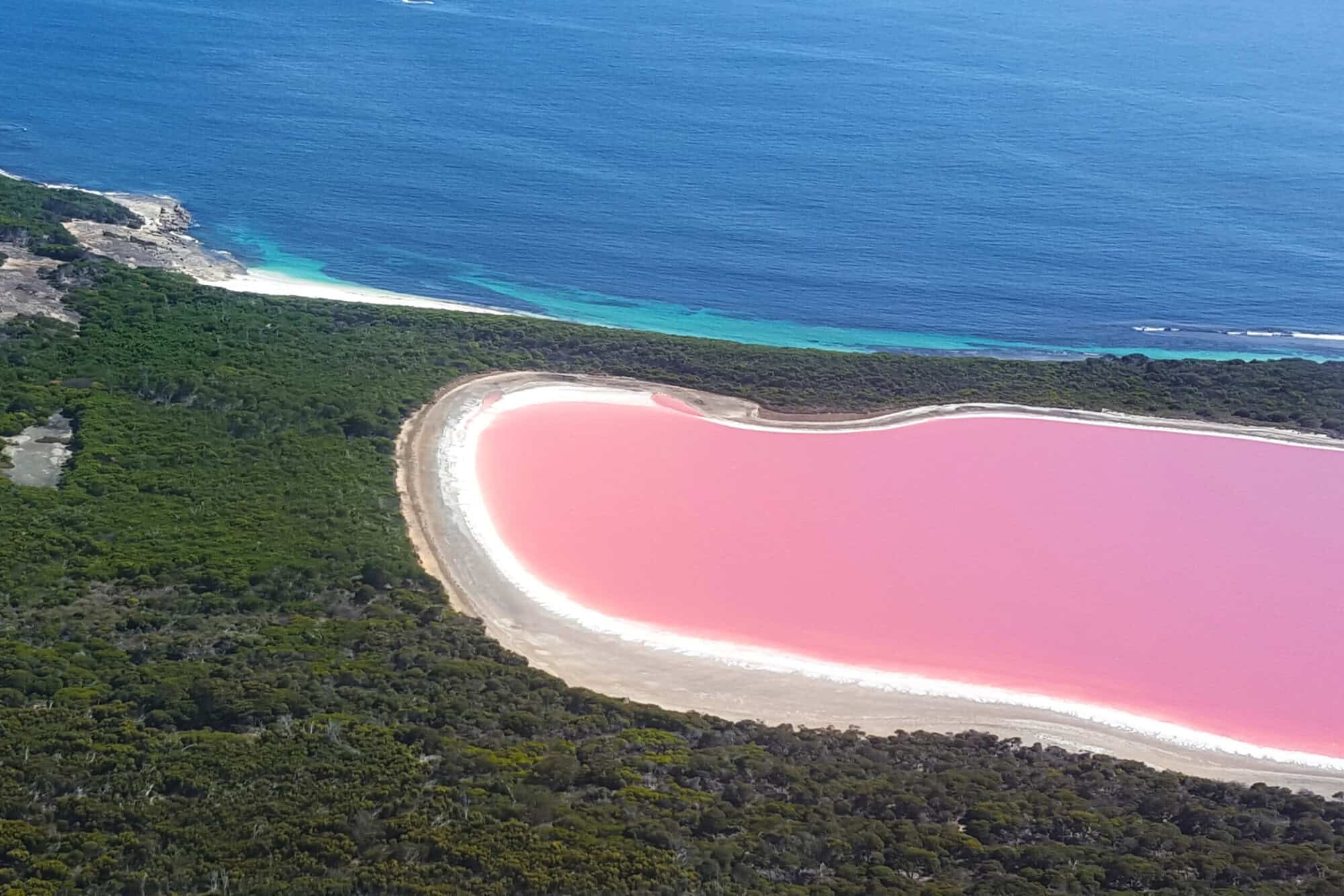
Lake Hillier (Australia)
If only Willy Wonka had opened his chocolate factory in Australia, perhaps he could’ve showcased a lake filled with strawberry milk! Despite the vivid intensity of its colour, scientists are still unsure of the actual cause of Lake Hillier’s hue.
Some attribute it to the presence of Dunaliella salina algae and halophilic bacteria, which thrive in its hypersaline waters. Unlike other pink lakes that change colour with the seasons, Lake Hillier stays permanently pink, whether viewed up close or from above.
Despite its almost radioactive appearance, the water is completely harmless to humans – although swimming in it is off-limits due to conservation efforts. The lake’s isolation adds to its mystique – it’s only accessible via air or boat and remains largely untouched.

Rainbow Mountains (China)
As if God himself had taken a paintbrush and exercised his artistic flair, the exceptional ‘Rainbow Mountains’ of China are a sight to behold…
The vivid stripes of red, blue, yellow and green across the foothills look almost man-made, as if concocted from the mind of a children’s author, but we can assure you that they’re entirely real and have resulted in a spate of tourist attention.
The mountains are situated within the Zhangye National Geopark and span 500 square kilometres. They were formed during the same geological shift that produced the Himalayas over 80 million years ago, and their colouration is the result of centuries of tectonic activity, climatic conditions, and the erosion of red terrigenous sedimentary beds.
If you want to find out more, you can read our feature on the topic!

Dallol (Ethiopia)
A place so bizarre that it looks like it inspired a verse in Sgt. Pepper’s, Dallol in Ethiopia is a bubbling cauldron of volcanic and hydrothermal activity. Its terrain consists of pools, formations, and tendrils that display an electrifying blend of sulphuric yellows, iron-rich oranges, and acidic greens.
The ground is encrusted with salt formations, some with pH levels approaching zero – temperatures here often exceed 45°C (113°F), making it one of the most extreme environments on Earth. The region’s harsh conditions and chemical composition make it nearly devoid of life, save for a few extremophile microbes that survive in its toxic waters.
Due to its uncanny resemblance to extraterrestrial environments, Dallol has become a key research site for astrobiologists studying how life might survive on planets like Mars or moons like Europa.
If you’re interested in an excursion to view some of these otherworldly landscapes, click the location name to view our destination pages or contact us directly to curate a bespoke trip. While this article is largely for entertainment purposes, many of these locations are accessible on a personalised trip! Contact details: enquiries@odyssey-world.co.uk / +44 117 313 7070!
