

SHARE:
The Healing Forests of Borneo
A veritable haven of verdant rainforest, Borneo sits unfailingly at the top of almost every must-visit bucket list – watching orangutans swing through the dense canopy, pygmy elephants roam the land and hornbill calls echo across the vital Kinabatangan River is truly one of the world’s unmissable experiences.
However, as the cliché goes, there’s often some trouble in paradise. Beneath the postcard beauty lies an insidious practice: for decades, Borneo has been at the epicentre of deforestation and invasive palm oil production, leading to significant environmental degradation and wildlife endangerment.
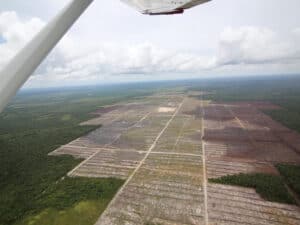 Palm oil is the world’s most popular vegetable oil and comes from the fruit of the oil palm Elaeis guineensis. It’s used in many processed foods, includingice cream, chocolate and cereals, as well as cosmetic and household products such as soap, toothpaste and shampoo. It’s also used as a raw material for biofuels.
Oil palm is actually an incredibly efficient crop. The palms start bearing fruit around 30 months after planting, and are productive for the next 20 to 30 years. They produce up to ten times more oil than any other equivalent vegetable oil crop.
Luckily, this deleterious practice is coming to an end. Malaysia’s Sabah state, on Borneo island, is looking to revolutionise its industrial practices with a decade-long initiative that will render it the go-to state for sustainable palm oil. This goal is underpinned by a target to increase protected areas to 30% by 2025, having stood at only 11% in 2000.
Backed by WWF, the ambition includes the preservation of many threatened species such as orangutans and pygmy elephants. This initiative will be further levied by incoming EU regulation set to come into force in November 2024 which proposes a more stringent approach, including blocking the import of goods linked to deforestation.
 Orangutans are Borneo’s pride and joy, and their preservation is paramount. There are a range of charities and centres within the country that champion these extraordinary creatures – Odyssey World’s long-standing partner, Orangutan Appeal UK, has been actively supporting Sepilok Orangutan Rehabilitation Centre since 2001 – the first centre in the world to dedicate itself to the rehabilitation of orangutans.
The centre is located in the Sepilok-Kabili Forest Reserve and includes a clinic, treatment ward and nursery. The ultimate goal is to return them to the wild as soon as possible. The charity also encourages the adoption of orangutans – around four years ago, Odyssey World adopted Agop, an orangutan that was found lost and emaciated by a farmer and subsequently nursed back to health at the centre. To read more about this heartwarming story (and how you can adopt an orangutan yourself), click here!
Orangutans are often referred to as our ‘cousins’ due to the high percentage of DNA we share (approximately 97%), and the similarities are evident: from using tools, conveying emotion through facial expressions and adept problem-solving skills, recently another parallel emerged – in a first, an orangutan was seen using a plant to self-medicate.
After an assumed conflict against a neighbouring male, Rakus, a Sumatran orangutan in Indonesia, had sustained a noticeable facial wound. Around three days later, he was seen feeding on a particular liana plant that’s rarely eaten by orangutans. Instead of swallowing, he used the plant as a poultice, applying it to his wound for almost ten minutes.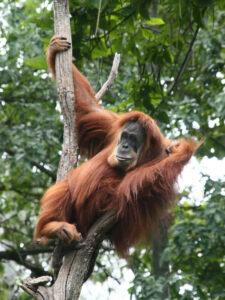
While the plant is known to humans as a pain-reliever, there has never before been evidence that animals know how (or why) to apply medicine to a skin wound. Isabelle Laumer, a primatologist and cognitive biologist stated that ‘researchers had never before observed orangutans in the area self-medicating like Rakus did and that it was not clear how he developed the behavior’.
“It’s possible Rakus learned to treat his wound through ‘individual innovation’,” Laumer said, “or he may have learned the behaviour culturally, from other orangutans, early in life”. Orangutans tend to learn sophisticated knowledge and skills, such as the ability to use tools and which foods are edible, from their mothers and caregivers.
There have been cursory observations of primates using plants for their medicinal purposes in the past – famous primatologist Jane Goodall noticed that chimpanzees ate the bitter pith of a particular daisy, but only when other behaviours suggested they were sick. Additionally, a 2008 study documented three females rubbing their bodies with a paste of chewed Dracaena cantleyi plant, which local Indigenous people use to address joint and bone pain.
It’s possible and even theorised that this knowledge is a form of genetic inheritance, meaning this information is transmitted from parents to offspring via their genetic code, which could imply Rakus did not learn this behaviour, but inherently knew it. This hypothesis raises a compelling possibility: rather than animals imitating humans, it was humans who discovered these plants’ properties by observing other animals.
For the time being, this is simply conjecture. But this intriguing story certainly reignites the understanding of how intertwined we are with nature, especially our closest ancestor, even if our lives may seem disparate. Encountering these incredible creatures in person serves to illustrate this indissoluble connection.
If you’re interested in an orangutan encounter or simply want to peruse and enjoy the tantalising features of Borneo, you can click here to view our destination page which contains a selection of varied and enticing itineraries. Alternatively, you can curate a bespoke adventure by talking to us directly! Email us at enquiries@odyssey-world.co.uk or call us any time (+44 117 313 7070)!
