

SHARE:
The beautiful rivers that form natural borders
Rivers have long been the lifeblood of civilisations. Almost every major city, metropolis or empire was situated a stone’s throw away from a capacious body of navigable water, and this is no coincidence; it’s by design. Be it to accommodate trade routes, agriculture, or simply the nutrients responsible for life’s existence, a sizable course of water is often a prerequisite for any flourishing society.
A river is a large stream of water, and to rive is to split or tear apart – while the origin of each word is purportedly distinct, this similarity is seemingly appropriate given that many of the world’s most significant rivers are used to clearly demarcate the boundaries between countries.
Thus, in this blog, we will dive into the beautiful and scenic rivers that constitute a natural border: the ecological importance of these rivers, the communities that thrive along their banks, and the efforts to preserve their beauty for future generations…

Zambezi River
Providing the nutrition and life force of a significant portion of Africa’s biodiversity, the Zambezi River is a grand and majestic ribbon of water starting its course in Zambia, touching Angola and Namibia and forming the border of Zimbabwe and Zambia, before meeting Botswana further downstream at the confluence with the Chobe River.
As it meanders through these countries, the Zambezi showcases its incredible beauty, even offering the phenomenal vista of cascading waterfalls such as Victoria Falls, which we’ve expatiated on in our recent blog, in which we detail the world’s most spectacular waterfalls (check it out here)!
All along the banks and edges of the Zambezi River one can spot wildlife and flora in an animated performance: from elephants bathing in its waters to crocodiles basking on its sun-drenched shores, the bountiful river is teeming with life.

Detian Falls
The impressively beautiful Detian Falls have been making the rounds recently. Despite being slightly undercover in the realm of tourist attractions, they also received a timely shout-out in our aforementioned blog detailing the world’s most spectacular waterfalls (which you can read here… or the link above)!
The name of this particular place can be confounding, as it depends on where you are. On the Chinese side, the falls are called Detian Falls, while on the Vietnamese side, they are referred to as Ban Gioc Falls, but either way, they’re the same beautiful sight!
Occurring on the Quay Son River, the gorgeous turquoise waters flowing from China through a pastoral landscape of rice fields and bamboo groves is an incredibly picturesque sight. The falls are 30 metres high and 300 metres across, and the cascade is an interweaving combination of multiple waterfalls, creating a mesmerising curtain of water that spans over 200 metres in width and plunges down approximately 30 metres.
Mekong River
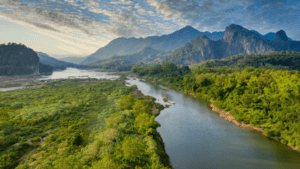
One of the longest waterways in all of Asia, the shapely serpentine curves of the Mekong River stretch across approximately 4,350 kilometers (2,703 miles) and through six separate countries. Like a vein permeating a body, it provides a significant lifeline for millions of people and wildlife: supporting agriculture, transportation, fisheries and much more!
Beginning in China, the river forms a border between Myanmar before flowing through Laos. It touches upon Thailand before entering Cambodia further downstream. Finally, the Mekong Delta in Vietnam marks the river’s culmination before it empties into the South China Sea.
Its length is so tremendous that it bears a different name in each country. In Thailand, it’s referred to as the Mae Nam Khong, meaning “Mother of Water”, in Cambodia, the river is known as the Tukh Khmum (ទុក្ខមុំ), which translates to “Great River”, and in Vietnam, it is referred to as the Cuu Long (Sông Cửu Long), meaning “Nine Dragons”, reflecting the numerous distributaries that branch out from the main river.
The river’s flow is characterised by seasonal variations, influenced by the monsoon rains and snowmelt from the Tibetan Plateau. Renowned for its impact on local ecology, it supports an array of unique flora and fauna, including iconic species such as the Mekong giant catfish, Irrawaddy dolphin, and Siamese crocodile.

Amazon River
Often referred to as the “lungs of the Earth”, this monumental watercourse needs no introduction. Spanning approximately 6,400 kilometres, the Amazon River clocks in as the second-longest river in the world, just trailing the Nile.
A thriving ecosystem that constitutes the life force of all the countries it touches, it begins its journey in the Peruvian Andes: Brazil and Peru have the most extensive parts of the river running through them, while it also forms part of the border between Colombia and Peru. The river’s distributaries reach into Bolivia, Ecuador, and even the edges of Venezuela.
The interconnectedness of the river helps support the economies of each country through transportation, fishing, and agriculture, as well as affecting almost every aspect of life, from the social fabric to the environmental health of the planet.
The Amazon rainforest itself covers an enormous 6.7 million square kilometres (roughly 28x the size of the UK!) and the river supplies the nutrients keeping it alive; providing the habitats to sustain over 10% of the world’s biodiversity, with copious endemic species such as the Jaguar, Pink River Dolphin and Giant Otter.
Shyok River
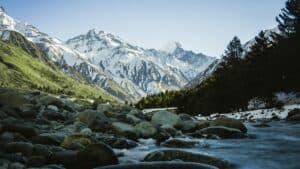
In contrast to the life-giving vitality of previous rivers mentioned, the Shyok River is known as the “river of death” due to its treacherous terrain and unpredictable waters. Despite the challenging environment, many areas along its course contain great beauty and scenery…
Originating from the melting glaciers of the Karakoram Range in the Himalayas, the river runs through the Ladakh region of India before entering Gilgit-Baltistan in Pakistan. The river’s journey is marked by an unusual alignment: it starts by flowing southeast, then takes a sharp turn northwest, running parallel to its earlier path. This peculiar flow pattern is believed to be influenced by ancient fault lines that direct the river’s course.
Along its route, there are many areas of incredible natural beauty, for example, the Ladakh Region of India, which showcases the dramatic backdrop of the Himalayas, displaying snow-capped peaks, deep valleys, and barren expanses, as well as Khaplu Valley, Pakistan, where verdant meadows, terraced fields, and traditional stone houses create a scene of pastoral tranquility.
If you’re interested in travelling alongside any of these exquisite natural borders, feel free to click each mentioned location to visit our destination page or contact us directly to personalise your own trip and visit the areas most impactful to you – either by emailing us at enquiries@odyssey-world.co.uk or giving us a call (+44 117 313 7070)!
