
SHARE:
Meet Australia’s unique wildlife!
Isolated from the rest of the world for millions of years and the sixth largest country on the globe, Australia’s unique and disconnected geographical position helped develop a unique ecosystem unlike any other. Most of its wildlife is found nowhere else in the world – 87% of mammals, 93% of reptiles and 45% of its birds are entirely endemic!
In fact, its distinct fauna caused quite a shock for the European settlers of the 17th and 18th centuries – from bouncing marsupials carrying their young in pouches, otherworldly egg-laying mammals, the haunting screeches of the Tasmanian devil, to deadly insects – there was both scepticism and supernatural paranoia amongst the ranks of those who ventured into what was assumed to be an endlessly inhospitable desert.
Thankfully, in the modern era, the facts have been parsed from the fiction, and fear has made way for adoration. Australia is now renowned for its pristine beaches, laidback surfer-dude enthusiasm, adorable creatures, and handsome celebrities. A trip ‘down under’ now has the quality of a ceaselessly sunny paradise, inviting a range of adventure and relaxation seekers to its picturesque shores.
To the many wildlife lovers out there ready to get up and close with some quirky characters, the following blog will expatiate on the wonderful wildlife present in Australia – from the cuddly koala to the feisty Tasmanian devil, we’ll have a glance at some of the most unique and tantalising wildlife (mostly) endemic to the Aussie nation!
Quokka
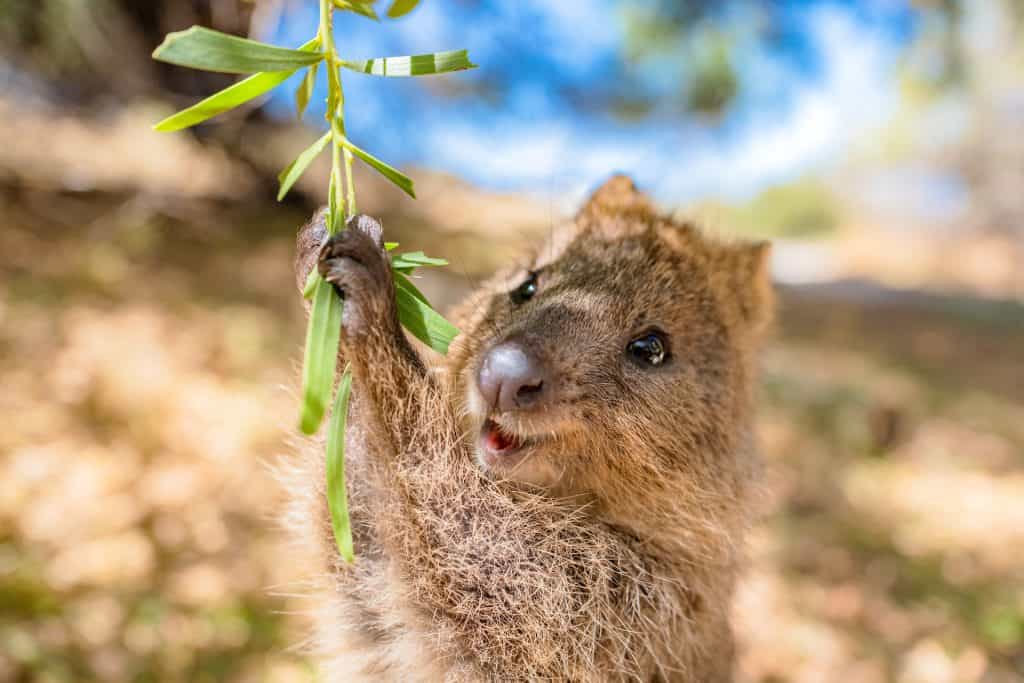
Commonly referred to as the “happiest animal in the world”, you may be familiar with the trend of travellers taking selfies alongside their beaming, cartoonish grin. Luckily, their exuberant appearance accurately reflects their inherently friendly and curious nature, a result of flourishing on an island with almost zero natural predators – what a peaceful life!
They belong to the macropod family, which includes kangaroos and wallabies, but this wasn’t always obvious – when Dutch explorer, Willem de Vlamingh, discovered the island in the late 17th century, he described the Quokka as a ‘kind of rat as big as a common cat’, and named their native island Rottnest Island, which has endured for perpetuity despite directly translating to “rats’ nest”.
Quokkas are most active at night. They are herbivores and feed on a variety of vegetation such as grasses, leaves and stems. During the day, they will shelter among dense vegetation and also create paths to use as runways for feeding. They can also climb more than five feet up a tree trunk to reach for a tasty leaf or berry, something even kangaroos and wallabies can’t do!
Despite their adorable appearance, it’s important to remember that quokkas are wild animals and shouldn’t be disturbed – while they are rarely aggressive, they can bite, and human interference can disrupt their ecosystem. The threat of habitat loss is also present, so conservation efforts must be undertaken to protect their populations.

Duck-billed platypus
Undeniably one of the weirdest, yet cutest mammals in the world, it may come as little surprise that when British scientists first laid eyes on the platypus in the late 18th century, they were certain it was a hoax!
“It naturally excites the idea of some deceptive preparation by artificial means”, wrote English zoologist George Shaw, and even cut the pelt with scissors in an attempt to try and find the stitches that attached the bill to the pelt…
The duck-billed platypus is, admittedly, a bizarre concoction of features: the bill of a duck, the body of an otter, the tail of a beaver, and the reproductive features of a reptile. At a time when grafting animals together to feign new species was rife, the scepticism was justifiable. However, its perplexing appearance is simply a result of its perfect adaptation to the species’ semi-aquatic lifestyle.
The platypus usually lives alone, making its home in freshwater systems. When they’re not looking for shrimp, swimming beetles, water bugs and tadpoles to eat, they spend their time in their burrows, which they build in the banks of creeks, rivers or ponds.
Along with the echidna, the platypus is the only mammal on the planet that lays eggs. Part of monotreme family of mammals, which are thought to be the most primitive of all mammals, a 122 million-year old fossil from southeastern Australia shows that in the middle of the dinosaur era, platypuses already existed!
Koala
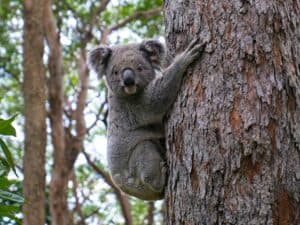
Found nowhere else in the world and a veritable symbol of Australia, the koala is renowned for its adorable appearance and temperate nature. Primarily found in forests and woodlands along the eastern and southeastern coastlines, as well as in some parts of South Australia, they are often referred to “koala bears”, despite not actually being bears, but marsupials.
Although toxic, eucalyptus leaves make up the majority of a koala’s diet. They can only absorb about 25% of the nutrients, so they need a lot, with adults consuming up to 1kg of leaves each night! While this diet would be harmful to any other animal, koalas have a specialised digestive system enabling them to break down the tough, fibrous leaves. However, a diet consisting almost entirely of eucalyptus leaves is not a high-calorie diet, leaving them with very little energy, hence why they spend around 20 hours per day sleeping!
Koalas have a distinctive appearance with round, fluffy ears, a large, spoon-shaped nose, and a stocky body covered in soft, thick fur. A mature male has a dark scent gland in the centre of his white chest which exudes a dark, sticky substance. He rubs this on his trees to indicate to other Koalas that this is his territory.
In terms of behaviour, koalas are largely solitary animals, spending most of their time high up in the trees. They are nocturnal creatures, although they may be active during the day as well. Unfortunately, the largest threat koalas face is habitat loss – they are currently classed as a ‘vulnerable’ species, having experienced a 30% decline in numbers since as recently as 2018! Booking a trip to Australia with a responsible tour operator such as Odyssey World can ensure that you are aiding efforts to protect and conserve populations of this iconic creature!
Tasmanian devil
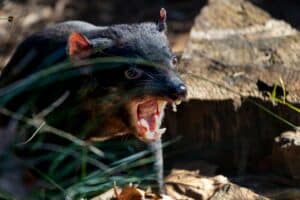
When you think of the Tasmanian devil, you may be reminded of the ferocious, maniacal, whirling Looney Tunes cartoon, and while it may seem like an exaggerated caricature of the creature, it’s not completely off the mark.
Discovered in the early 19th century, its moniker of ‘devil’ was well-earned – from its fierce temperament, spine-chilling screeches, and ravenous behaviour, the first Europeans to set foot in Tanzania assumed they were hearing evil spirits… it’s hard to imagine they had a sound night’s sleep upon arriving.
Tasmanian devils are strictly carnivorous, surviving on small prey and feasting on dead animals. Being voracious eaters, they will consume literally everything – including hair, organs, and bones, and use their muscular jaws and sharp teeth to deliver one of the most powerful bites of any mammal in the world.
Despite their pudgy appearance, devils are surprisingly agile, able to climb trees and swim across rivers. Their distinctive foul odour is, in fact, a stress signal, and if left unprovoked does not arise. In fact, they are typically not aggressive towards humans at all and actively try to avoid confrontation, which is generally easy given the mammals’ proclivity towards solitude and nocturnal tendencies; mostly spending their days alone in hollow logs, caves, or burrows.
Unfortunately, Tasmanian devils are now considered severely endangered. Not only is their habitat being encroached upon by urbanisation, but a contagious, and highly specific form of cancer found only in this species has become pervasive: known as devil facial tumour disease (DFTD), this unsightly condition is decimating populations. Booking with a responsible tour operator such as Odyssey World ensures that your trip will only use services, accommodations and establishments that support conservation, helping prevent any unwanted harm to devil populations.

Sugar glider
Nature’s very own inspiration for the wingsuit worn by base jumpers, the doe-eyed sugar glider makes it all the more adorable! These furry flying creatures have a very unique body – after launching themselves into the air, they spread their limbs to engage the ‘gliding membrane’, acting like a parachute allowing them to drift through the air for up to 50 metres! Click here to witness this mesmerising feat!
The ‘sugar’ element of its name derives from its appetite – as you can guess, they love to eat all things sweet! Consisting of flowering plants, fruits, sap from eucalyptus trees, insects and even bird eggs.
Sugar gliders are social animals, living in shared nests of up to seven individuals and their offspring. In their natural habitat, they primarily inhabit forests, woodlands, and scrublands, where they dwell in tree hollows or nests. They are also the largest marsupials to enter a ‘torpor’ state – a form of hibernation to survive during cold days or periods of famine.
Recent research has revealed that what was thought to be a single species of sugar glider actually comprises of three: known as the sugar glider, savanna glider and Krefft’s glider. Luckily, unlike many mammals on this list, they have been classified as “least concern” on the list of potentially endangered species, this is in part thanks to their populations in protected natural areas and their introduction in areas previously uninhabited, such as Tasmania.
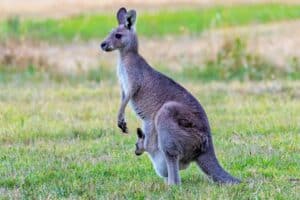
Kangaroo
What is a list of Australian wildlife without a mention of their trademark character, the kangaroo? With their famously powerful legs allowing them to hop across the landscape, baby-cradling pouch and staggering height of over 6 feet, this bouncy creature is synonymous with the great outback!
Kangaroos possess muscular hind legs, a long, strong tail, and small front legs. They belong to the family Macropodidae, which fittingly means “big foot”, and are the only animals who use hopping as their primary means of travel. Thanks to their large feet, kangaroos can leap 30 feet in length and 10 feet in height, as well as reaching speeds of 44 mph – over 17 mph faster than Usain Bolt!
Despite the shocking amount of muscle showcased by posing males, kangaroos are herbivores, feeding primarily on grasses, shrubs, and occasionally herbs. Generally social animals, they tend to live in groups known as mobs or troops, and when a baby is born, known as a ‘joey’, they are just one inch long (roughly the size of a grape), and must crawl unassisted into the safety of their mother’s pouch. At around 4 months, the joey emerges from the pouch for short trips and to graze on grass and small shrubs, and at 10 months, the joey is mature enough to leave the pouch for good.
Kangaroos hold cultural significance for indigenous Australians, often being depicted in art and folklore. Over time, they have become symbolic of Australia to a broader degree, representing the uniqueness and particular character of the land’s quirky endemic wildlife.

Wombat
The adorable wombat is another of Australia’s fascinating marsupials – built like short, stocky bears, these creatures are actually related to koalas and kangaroos. There are three species of wombat: common, bare-nosed, and hairy-nosed. The common wombat has coarse fur and short, round ears while the hairy-nosed wombats have soft fur and much larger ears.
Being expert diggers, they utilise their powerful claws to excavate extensive burrow systems which serve as their homes, as well as shelter from predators and harsh weather. If threatened, a wombat dives headfirst into its tunnel, blocking the entrance with its sturdy backside. They have extra-thick skin on their rear so a bite or a scrape isn’t too severe. Their burrows also provide refuge for other animals during bushfires and extreme temperatures.
While they usually waddle along, very much enhancing their cuteness, if threatened they can reach speeds of up to 24 mph thanks to their powerful hind legs – faster than 99% of humans! Although like kangaroos and koalas, wombats spend most of their time grazing; using their rodent-like teeth and strong jaws to chew foods like grasses, roots, shoots, tubers, and even tree bark. A special stomach gland helps wombats easily digest tough food.
Wombats are habitat tolerant, meaning they can be found in various environments: they tend to inhabit forested, mountainous, and heathland areas in southern and eastern Australia, including Tasmania. Typically solitary, although coming together during mating season, they are generally shy and timid but can become aggressive if threatened.
Their exact evolution remains somewhat unclear, but they are thought to have diverged from other marsupials as long as 40 million years ago. While modern wombats are small and rotund, as with the likes of other prehistoric Australian megafauna, their ancestors would have been larger than humans – even weighing up to 360 kg!
For those interested in becoming acquainted with Australia’s unique fauna, contact us directly to personalise your own itinerary! While you can visit our Australian destination page for more information, our packages are currently under redevelopment and will be reuploaded soon with all new additions! Either way, head on over, as by the time you’re reading this they may have been published. If not, feel free to email us at enquiries@odyssey-world.co.uk or call us directly (+44 117 313 7070)!
