

SHARE:
The enigmatic mystery of Easter Island
Often cited as one of the greatest mysteries of human civilisation, the ancient head statues of Easter Island exude an expression of subtle smugness as academics and archaeologists vie to uncover their age-old secrets.
This triangular island, 14 miles (23 km) long by 7 miles (11 km), has over 1,000 Moai statues: gargantuan heads sculpted from the island’s volcanic stone, with some reaching up to 10 metres tall and weighing up to 80 tonnes!

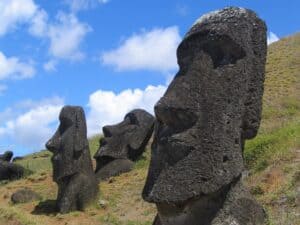
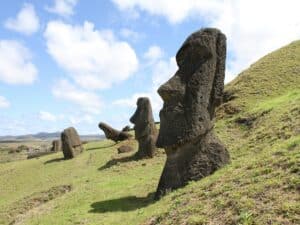
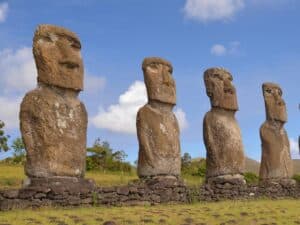
Also referred to as Rapa Nui, its original Polynesian name, it is technically a Chilean territory, despite being located over 2,300 miles away. This remote location makes it one of the most isolated locales in the world – while there, you are the furthest removed from any populated place on the entire planet!
The island itself is said to have formed around 750,000 years ago (fairly recent by geological terms) due to a series of massive volcanic eruptions. The island is dominated by two extinct volcanoes – Rano Raraku, where the majority of the famous statues were carved, and the striking Rano Kau, an enormous crater that looks as if it’s the site of a meteor.
The first settlers were speculated to have arrived from the Polynesian Islands by sea using double-hulled canoes around 1,200 years ago. While the environment of Rapa Nui was harsh, challenging and severely limited in size, the island’s volcanic soil allowed for the cultivation of crops like sweet potatoes and taro.
Over time, the population on Easter Island grew, and the society became more complex. The civilisation reached its zenith around the 17th century, amassing an estimated population of around 15,000. However, as the population increased, the island’s diminutive size became ill-suited to support it, causing severe deforestation and resource depletion.
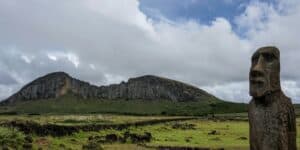
By the time Dutch explorer Jacob Roggeveen arrived, the population had significantly declined, and the islanders were facing social and environmental problems. The colonial discovery of the island occurred on Easter Sunday, lending to its well-known moniker. Not only did the interaction between the Europeans and the islanders enact a bloody conflict, but the invaders brought diseases such as smallpox, devastating the already impacted population.
Unfortunately, but inevitably, subsequent European contact led to further exploitation. By the mid-19th century, the population had been reduced to a fraction of its pre-contact numbers, and many of the original society’s artefacts had been destroyed, as well as the elimination of all who could read their writing.
With so few of the original artefacts intact and their written language indecipherable, the mystery of its culture, especially in regards to the monolithic carved heads, has burgeoned into worldwide curiosity.
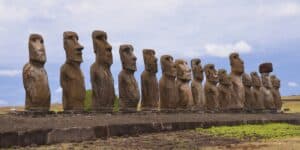
There are no (or at least very few) definitive answers, but a range of theories exist: many believe the heads represent dead ancestors, with human bones being found near many of them, indicating burial zones. Some of the statues have a red stone hat or topknot, these may resemble chieftains or clan accoutrements; members with additional status believed to possess supernatural significance.
The statues primarily gazed towards the land, supposedly standing guard over the populace. However, seven of them are looking seaward. Easter Island has low rainfall and many of the sculptures are close to freshwater springs, possibly as guardians of water. The statues could serve to protect natural resources on the island.
The remote location of the island, thousands of miles from land, and the imposing size and almost sinister appearance of the statues gives Easter Island the atmosphere of an adventure thriller – one you can be part of!
Our popular Chile Central & Northern Desert itinerary gives you three days of in-depth exploration on the island to walk in the footsteps of those who blessed Rapa Nui with its fascinating culture. “It’s a long flight from Santiago”, writes our MD Felicia Severns, “but visiting one of the most remote, mystical and spiritual UNESCO sites in the world, is a journey worth taking”.
Alternatively, check out our Chilean destination page for more packages or contact us directly, either via enquiries@odyssey-world.co.uk or telephone (+44 117 313 7070) to personalise your own adventure and plan your own bespoke trip!
