

SHARE:
Unravelling the Legacy of the Pyramids
One of the most enduring and perennial symbols of the ancient world, the Pyramids of Giza have stood the test of time in a way that many architectural marvels of bygone eras would meet with envy. Their monolithic stature, precise engineering and enigmatic aura have elicited a flood of curiosity – from myths and speculation about their origin and spiritual significance to films, books, and cultural intrigue that spans thousands of years.
 The pyramids were erected during Egypt’s fourth dynasty of the Old Kingdom – roughly 2,600 BC (approximately 4,600 years ago) – for the pharaohs Khufu, Khafre, and Menkaure. They are now the only remaining edifice of the Seven Wonders of the Ancient World. To convey exactly how long ago that was, when the last woolly mammoth passed and the species met extinction, the pyramids would have already stood for a thousand years!
In fact, the Pyramids of Giza were more ancient to the ancient Romans than the Romans are to us now, and the Romans themselves were tourists of Egypt, much in the way we travel today – the wealthy would peruse the Pyramids, reside in luxury villas, and pursue cultural enrichment.
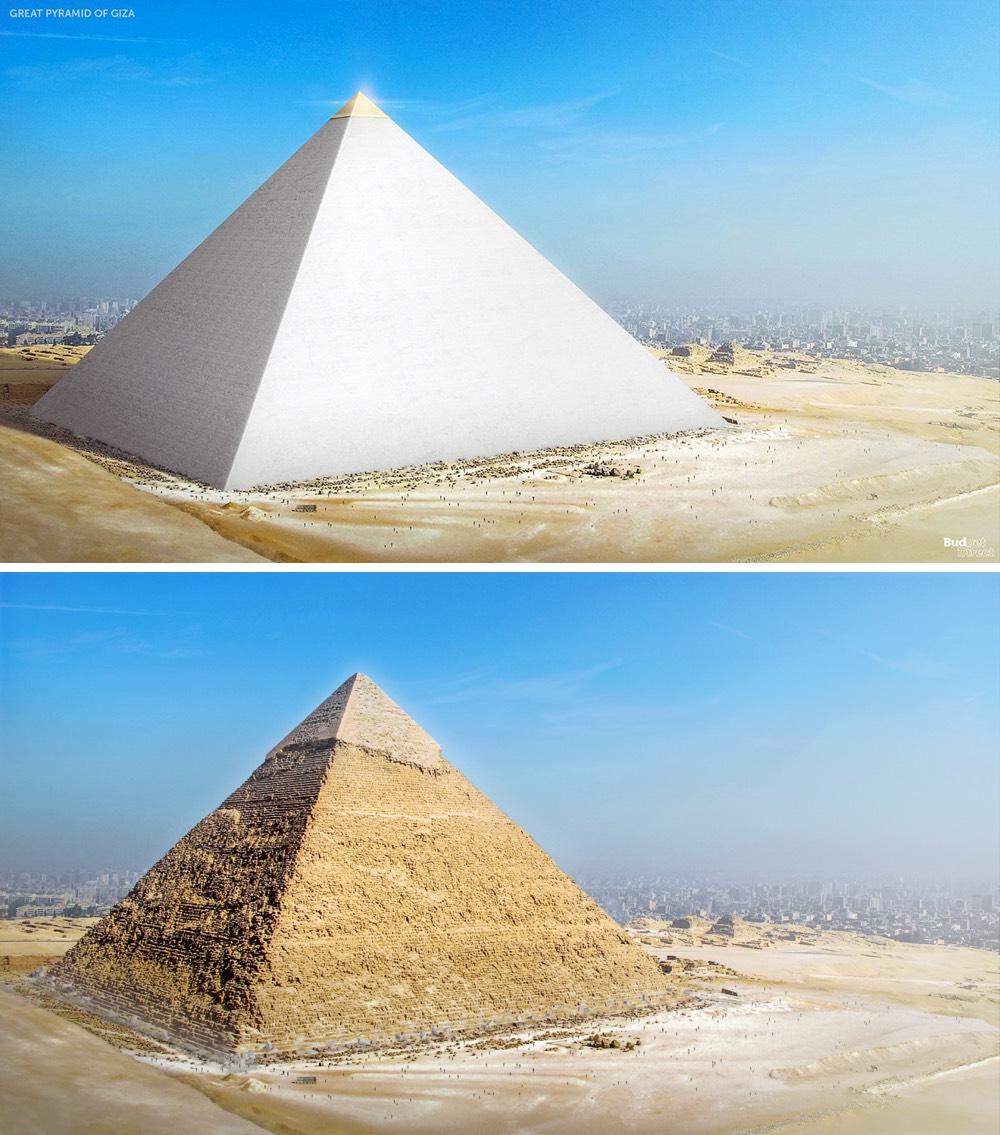
 Initially standing at 481 feet, the Great Pyramid was the world’s tallest human-made structure for more than 3,800 years. What can be seen today is the underlying core structure, but at the time of their inception they were encased in limestone and would have appeared perfectly smooth and blindingly white with a solid gold capstone – perhaps similar to this artist’s impression.
In 1900, the capstone of the now-collapsed Black Pyramid was found. Originally standing at 344 feet, it would’ve appeared meagre compared to the Great Pyramid, yet the capstone was constructed from black basalt (a durable volcanic rock) and weighed 4.5 tonnes, approximately the weight of three cars.
One of the reasons why most of the pyramids remain so well-preserved is because of the unique form of mortar used – it’s stronger than actual stone, but the exact composition is unknown and remains the subject of research.
Shockingly, the (singular) Great Pyramid is made from 6.3 million tons of material, which is more material than it took to build all of the churches and cathedrals in England since the time of Christ. To put it another way, there is enough stone to build a 10-foot wall around France. The pyramid’s base covers 13 acres and is level to within 1cm.
There is a common misconception that the pyramids were built by slaves. The envisaged idea of overworked, aggressively perspiring peasants heaving heavy bricks in the scorching sun is a popular perception, but it couldn’t be further from the truth: the labourers who built the pyramids were highly skilled, privileged artisans who were paid handsomely for their work.
On top of that, workers frequently took sick days, with excuses ranging from “trouble with eye”, “stung by scorpion” and even “brewing beer”, which was actually a very popular activity in ancient Egypt. These sick days were recorded on a tablet, just as your employer may receive your email of absence on their iPad (well, not quite).
 For a long time, the cultural consensus believed any major discoveries regarding the pyramids were behind us. Hieroglyphics were deciphered in the 19th century, Tutankhamun’s tomb was unearthed in the 20th century as well as the discovery of solar boats – these findings, while not directly related to the pyramids, certainly provided ample insight into ancient Egyptian culture.
However, in the last few years an exciting discovery has emerged – a revelation befitting an Indiana Jones film – a massive, mysterious void was discovered within the Great Pyramid! Measuring at least 100 feet, an advanced new technology has revealed via structural scanning that there is likely a hidden room or chamber as yet unfound!
The project, aptly known as the ScanPyramids initiative, has plucked experts from all over the world in one of the largest studies of the pyramid ever attempted. The technology, known as Muon tomography, essentially uses an advanced form of x-ray to detect differences in density within the pyramid.
The “Big Void” is located just above the Grand Gallery and the evidence has been corroborated by multiple surveys. Being encased in rock, it’s physically inaccessible, so unveiling its content poses engineering challenges – excavating and entering traditionally is risky and could compromise its structural integrity. Alternatively, deploying a small, manoeuvrable robot equipped with cameras could be a suitable option.
“Whether it is a chamber, or a construction anomaly, or something else is not possible to say at this time. But my view on it has always that it is there, it is big and it is worthy of further investigation,” said Peter Der Manuelian, a professor of Egyptology at Harvard University.
 Interestingly, and further clouding the enigma of the pyramids, the mission used cutting-edge technology in an attempt to uncover how the pyramids were built and explain their longevity – yet after eight years, these questions remain unanswered.
It’s little wonder so many eccentric theories are borne of the pyramid’s mystique. In many ways, truth is stranger than fiction. For example, the numerical latitude of the Great Pyramid corresponds precisely with the speed of light (299,792,458 m/s), and the three main pyramids happen to align with the Orion star constellation – whether that was purposeful or not is still a subject of debate!
The pyramids have become such a steadfast tourism staple it’s easy to overlook just how remarkable and fascinating they are! They remain an extant, unwavering paragon of human engineering and innovation; transporting us back in time while cultivating a profound sense of awe.
If you’re interested in a trip to Egypt, you’re in luck! Odyssey World have recently started offering itineraries that flow through this historical land just like the Nile. To view them, visit our Egypt destination page or contact us directly to curate your own experience – either by emailing us at enquiries@odyssey-world.co.uk or calling us directly (+44 117 313 7070)!
