

SHARE:
Tanzanian Mythbusting
Safari is particularly susceptible to confident misinformation. Our team recently travelled outside the normal peak-season period to meet with our local partners, revisit some of our favourite lodges and experience Tanzania towards the end of its green season. The prices were lower, the landscapes were lush and the safari vehicles considerably fewer. Most importantly, the wildlife had not received the memo that it was supposed to disappear.
Here are some of the most persistent myths about travelling through Tanzania, put to the test:
Myth: Game viewing is poor outside the dry season
Busted: Tanzania remains an excellent safari destination throughout much of the year.
Although the dry season can make animals easier to find around permanent water sources, the green season has its own advantages. Landscapes are lush, visitor numbers are lower and accommodation prices can be considerably more affordable. The savannah grassland of the Ngorongoro Crater offered plenty of wildlife sightings during our visit. The green foliage did not make the animals noticeably harder to see. In fact, the big cats were often out in the open, as they do not particularly like sitting in wet grass. We were also frequently the only vehicle in certain areas, meaning we could stop and enjoy the wildlife without feeling hurried by other vehicles.
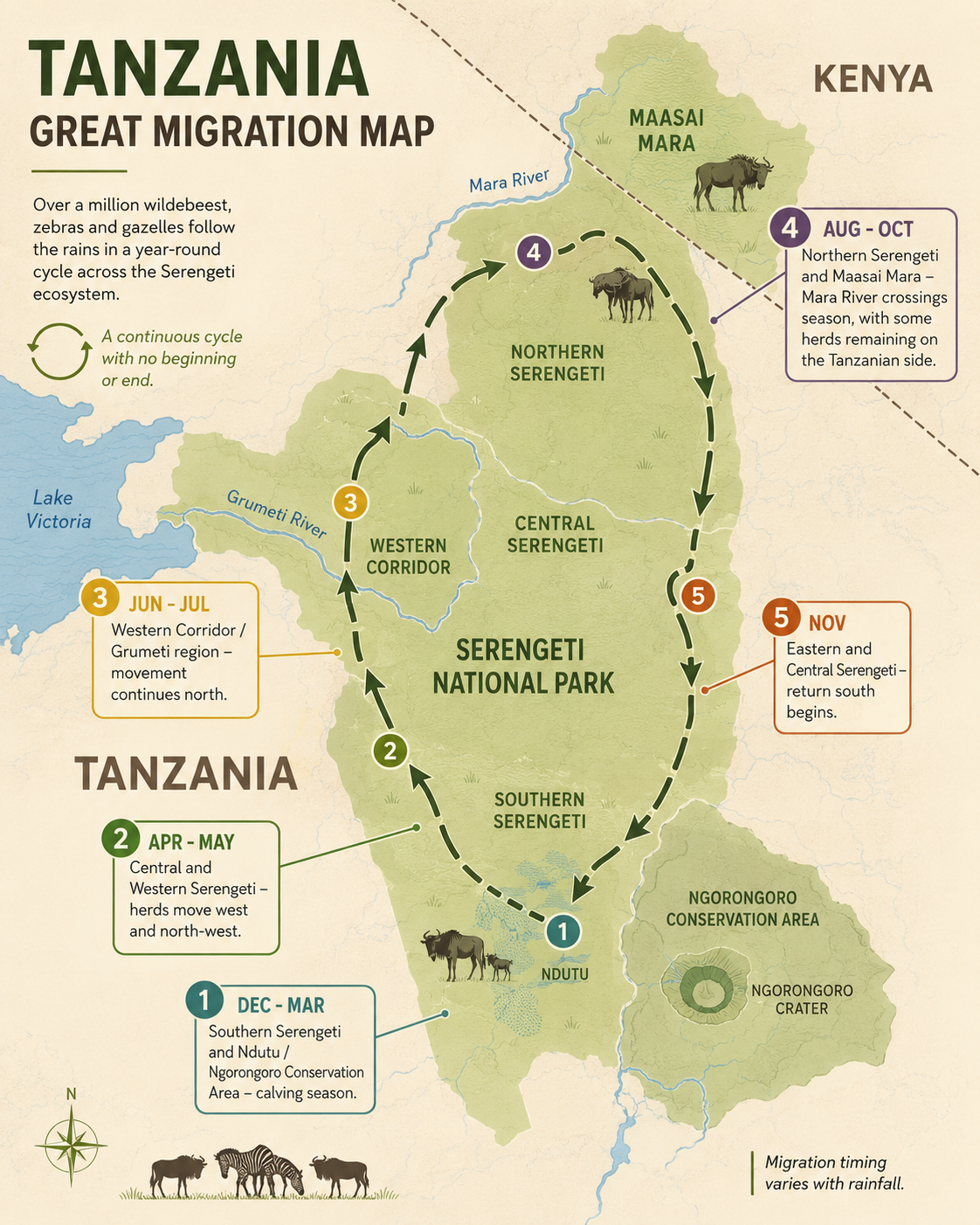
Myth: The Great Migration only happens in July, August and September
Busted: The Migration is a continuous, year-round movement through the Serengeti and Maasai Mara ecosystem.
More than a million wildebeest, accompanied by zebra and gazelles, move in a broad circular pattern in search of fresh grazing and water. Their location changes throughout the year according to rainfall. Between roughly March and May, the herds are generally found around the central and western Serengeti. Later in the year, many move towards the northern Serengeti and across the border into Kenya.
During our trip, we stood outside and listened to the sounds of the Serengeti as the sun went down. The Great Migration sounded almost like a river flowing. The famous river crossings are extraordinary, but they are only one part of a much larger natural cycle.
Myth: Calving season is a lesser time to visit
Busted: Calving season is one of the great highlights of the Migration.
During February and March, hundreds of thousands of wildebeest calves are born across the southern Serengeti and Ndutu plains. The abundance of young animals also attracts predators, creating some of the most dramatic wildlife encounters of the year. Even later in the green season, there were plenty of opportunities to see baby animals. Their clumsy attempts at imitating their parents were a constant source of entertainment.
The possibility of rain should not automatically make this period less appealing. For many wildlife enthusiasts and photographers, it is precisely why they travel.
Myth: Tanzania is always hot
Busted: Temperatures vary considerably according to altitude, region and time of day.
Zanzibar and Tanzania’s Indian Ocean coast are generally warm, but safari areas can be surprisingly cool. The Ngorongoro Highlands sit at considerable altitude, and early-morning game drives around the crater rim can feel distinctly cold. Light layers, a fleece and a jacket are often more useful than packing exclusively for tropical heat.
Myth: The Maasai Mara is in Tanzania
Busted: The Maasai Mara is in Kenya. The Serengeti is in Tanzania.
The two form adjoining parts of the same wildlife ecosystem, which explains the confusion. Migrating herds move between the northern Serengeti and the Maasai Mara, crossing an international border in the process. Travellers can witness the Migration from either country, but routes, seasons and logistics differ depending on which side of the border they visit.
Myth: Travelling outside peak season means settling for less
Busted: It means experiencing Tanzania differently.
The green season brings lower prices, fewer visitors, dramatic skies, greener scenery and abundant wildlife. Some roads may be more difficult after heavy rain, and the precise route must be planned carefully, but this is not an inferior version of Tanzania.
Our latest visit showed that travelling outside the conventional peak season can be every bit as rewarding. The landscapes were greener, the parks were quieter and the wildlife encounters remained exceptional.
If Tanzania’s wildlife and landscapes have caught your imagination, visit our destination page to browse itineraries and further features, or contact us directly to plan your own safari – enquiries@odyssey-world.co.uk / +44 117 313 7070.
