

Perhaps we see ourselves in them; and it’s the tool-wielding, facially expressive, playfully rogue familiarity that makes witnessing our closest relative in the animal kingdom such a profound and unforgettable experience.
If you’ve ever asked someone about their gorilla trekking experience, you will invariably encounter the same response: it’s a life-changing experience! Standing mere feet away from these gentle giants in their forest habitat is as humbling as it is extraordinary – young gorillas rough and tumble under the patriarch’s supervision, families eat together, groom one another, and play together, all while dimly aware of a group of harmless yet inquisitive hairless primate onlookers (that’s you!).

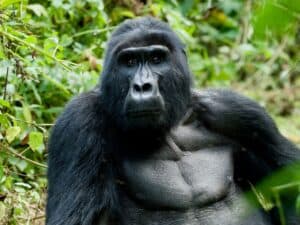
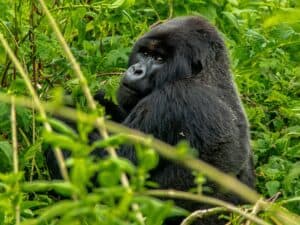
Sadly, there are only around 1,000 mountain gorillas left on the planet, with most presiding in the Virunga Mountains of Rwanda and the Bwindi Impenetrable Forest of Uganda, as well as small populations in the Democratic Republic of Congo. Threatened by poachers, the forests that shelter these populations are now heavily protected.
The rarity of such an encounter in many ways makes these sightings even more spectacular – the gorillas remaining are in such sparse numbers that trackers are able to give them individual names, identify their faces, and become acquainted with their distinctive and animated personalities.
If you’re interested in an excursion to witness these fascinating creatures, one of the initial dilemmas is choosing where to see them, which typically concerns a choice between Rwanda and Uganda. Unfortunately, the verdict isn’t swiftly decisive, as both have a healthy array of strengths and weaknesses contingent upon your particular travelling tendencies.
Fortunately, we have our expert ground operators and Odyssey World Africa specialist, Madri to help you make an educated and well-informed decision on your primate pursuits.
Features of Uganda:
It’s easier and cheaper to gain a permit: The cost of a permit in Uganda is roughly $800 on average, compared to Rwanda’s $1,500 (almost double). Uganda also offers a larger number of groups for trekking, typically increasing the availability and ease of securing a permit.
You can spend more time in the gorillas’ company: There is a Gorilla Habituation permit ($1,500) for a more in-depth experience, where you get the opportunity to spend 4 hours with a Gorilla family (alongside researchers and rangers) to help get them used to being closer to people for future conservation efforts, however these families are not yet habituated, and the permits are only available in the Rushaga area of Bwindi Impenetrable Forest in Uganda.
Bwindi Impenetrable Forest doesn’t require acclimatisation: The altitudes in Bwindi range from roughly 1,100 to 2,600 metres above sea level, which is significantly lower (and more manageable) than the altitudes of Volcanoes National Park in Rwanda, which range from 2,400 to 4,500 – this can definitely be felt on treks that venture further up the slopes where the vegetation also gets thicker and the climb gets steeper.
Bwindi is, as the name suggests, an “Impenetrable Forest” with dense vegetation to navigate, but this does not necessarily mean you will struggle to spot the gorillas – you may well find them resting in a large clearing deep in the forest. Prepare for your hike – wear nonslip hiking boots, pack a rain jacket, suncream, snacks and water. You never know when you set off what conditions await and how long or strenuous your trek might be.
There are more gorilla families: The trekking locations of Uganda collectively host around 21 gorilla families compared to Rwanda’s 12, resulting in more varied and less crowded experiences.
Features of Rwanda:
You don’t have to travel as far to reach the gorillas: For a quick gorilla trekking experience, one can fly into Rwanda and be at the Volcanoes National Park within a 3 – 4 hour drive from Kigali. In Uganda, one would need to fly in from Entebbe to avoid a lengthy road trip of 8 – 10 hours.
Viewing the gorillas is easier/less obstructed: Due to its open vegetation, the bamboo forest zone in Volcanoes National Park offers easier gorilla viewing opportunities compared to the relatively dense undergrowth of Bwindi National Forest.
There are more high-end accommodation options: Both offer a range of accommodation from budget to 5*, but Rwanda does shine in terms of ultimate luxury with brands like Singita, One & Only & Wilderness.
Rwanda is a more ‘Westernised’ country: Rwanda has made significant strides in political stability, security, and infrastructure. Some travellers might find that Rwanda feels more ‘Westernised’ compared to a more ‘authentic African’ feel in Uganda. Plus, the proximity to Kigali, with its high-quality medical facilities, can help provide peace of mind.
In truth, every gorilla trek is unique, influenced by factors such as the gorilla families’ location, their activity levels, and the day’s weather. Whether in Rwanda or Uganda, your professional Rangers are dedicated to ensuring you have an extraordinary encounter with these magnificent creatures.
However, if you truly can’t decide which – why not pick both? Our Uganda & Rwanda Gorilla Safari is an 8-day adventure that finds you seeking gorillas in both countries, as well as elusive golden monkeys, and even scoping a wide variety of wildlife – from elephants, lions, hippos, and baboons – in Southern Queen Elizabeth National Park!
If you would like to browse our many gorilla-focused Ugandan and Rwandan itineraries, feel free to visit our destination pages (by clicking the links on each country above) or contacting us directly – we can refer you to our African specialist and help curate your very own bespoke and personalised gorilla trekking experience: either email us at enquiries@odyssey-world.co.uk or call us directly (+44 117 313 7070)!
?)