
SHARE:
The endemic monkeys of Borneo
When you think of Borneo, what do you think of? No doubt verdant, beautiful scenery, warm hospitality, and adventure tourism, but that probably wasn’t your first association. You can probably see where this is going, especially given the title of this blog you knowingly clicked on – orangutans, of course!
Borneo and its orangutans are an inseparable duo – these charismatic inhabitants draw visitors from all over the globe, with copious tourists eager to watch these red-haired primates go about their daily jungle life. Not only are they fascinating to observe, but they are paramount to Borneo’s entire ecology: they disperse seeds, pollinate flowers, and provide food for other animals, lending the befitting nickname of ‘gardeners of the forest’.
While orangutans are arguably soaking up the brightest rays of the tourist spotlight, the primate population of Borneo is considerable, consider this: the forests of Indonesia contain over 10% of the world’s flowering plants, 16% of the world’s reptiles and amphibians, 17% of the world’s birds and 12% of the world’s mammal species – among these are over 20 species of primate.
The Indonesian archipelago is undoubtedly replete with biodiversity, but what separates Borneo (and its surrounding areas) is the number of species endemic to its native population. These particular mammals can’t be found anywhere else in the world, they exist purely in the ecological paradise of Borneo.
So, without further ado, let’s delve into the exclusive club of Borneo’s very own VIPs:
Gibbons


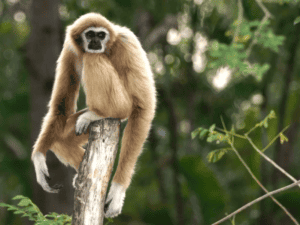

The gibbon would put any Olympic acrobat to shame – they are masters of the trees, artfully swinging hand over hand until it almost appears like they’re flying! Despite being commonly referred to as monkeys, gibbons are actually classed as apes. However, they’re distinct from ‘great apes’, such as gorillas, orangutans and chimpanzees.
They are significantly smaller than the rest of the ape family, with most species falling between 40 to 65 centimetres. They lack a tail, and their long, dense hair ranges in colour from cream to black, helping distinguish them from other primates.
The most romantic of the primates, gibbons form monogamous relationships and start each day by singing at sunrise. In fact, they sing together in what are known as “duets” and each family has its own unique song! These melodic performances help establish territory boundaries, attract mates, and reinforce social bonds.
There are two main species of gibbon endemic to Borneo: the Eastern Gray Gibbon (also found in nearby Sumatra), and the Bornean White-bearded Gibbon, which are only found in Borneo and are recognisable for their distinctive white cheek tufts or “beards,” which are more prominent in males.
Langurs
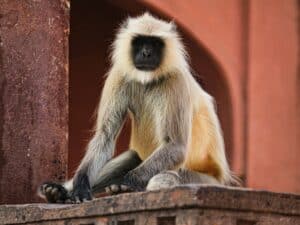
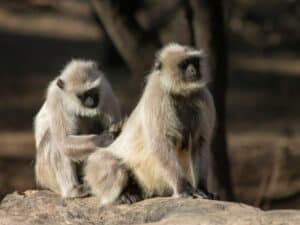

The remarkable langur is smaller than most primates, with males only reaching around 25 inches in length, but they more than make up for it in character – typically bold, curious and gregarious, these primates are known for their vocalisations, including alarm calls.
They live in groups known as ‘troops’ typically numbering around 125 individuals. These troops contain complex and intricate social structures, with every individual having specific roles and ranks.
Known as Old World monkeys (originating from a common ancestor around 30 million years ago), langurs are leaf-eating monkeys that belong to the subfamily Colobinae. While many species of langur are found in various regions of Asia, such as India, China, Indonesia, and Malaysia, there are a select few specifically endemic to Borneo and Sumatra.
These include Hose’s Langur, Black-Crested Sumatran Langur, Maroon Langur, and Silvered Langur – each sharing unique characteristics: from the ostentatious reddish fur of the Maroon Langur to the silver halo of hair caressing the Silvered Langur’s face.
Proboscis Monkey

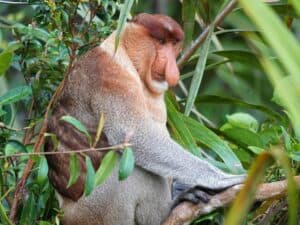

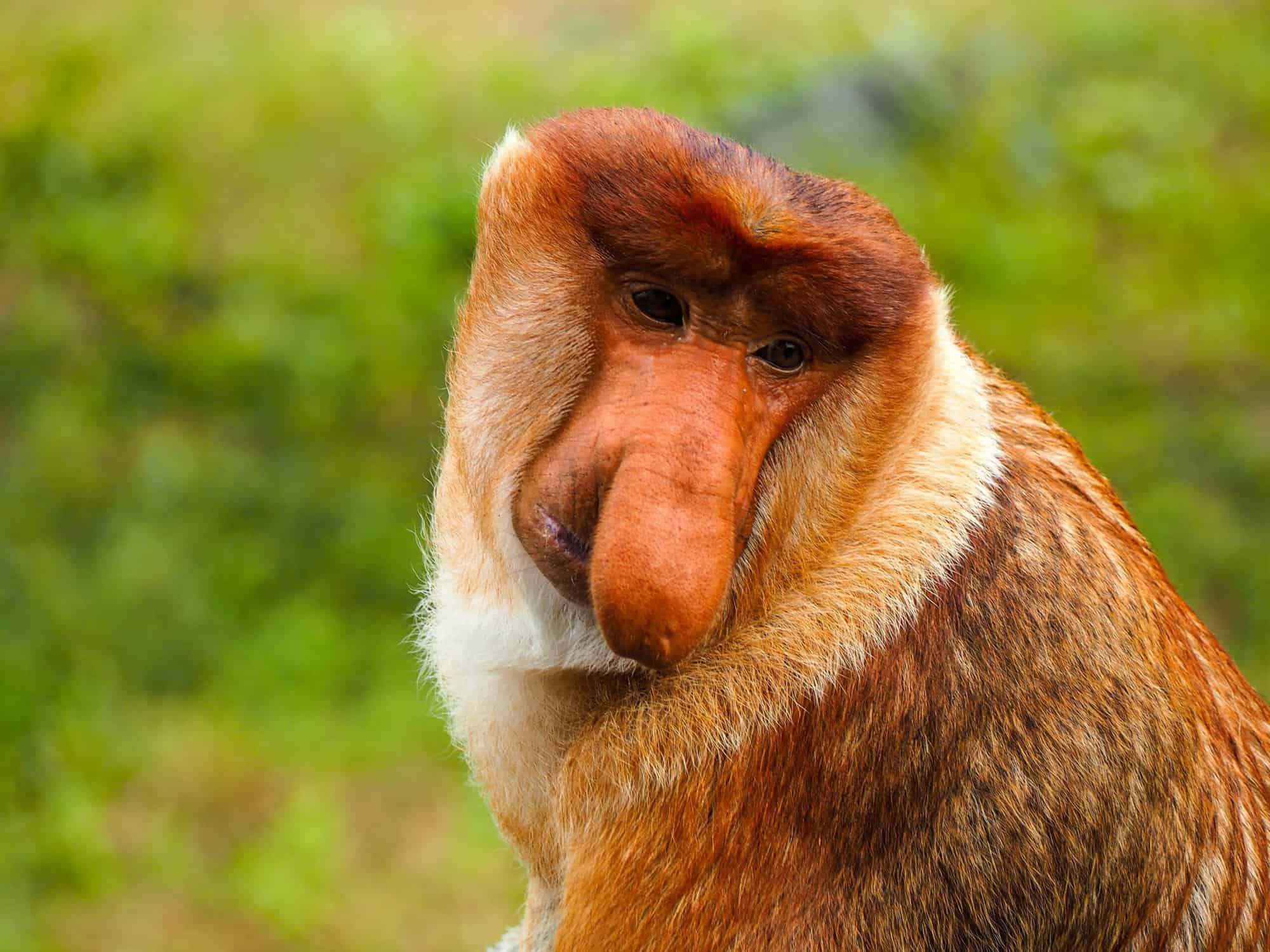
Also known as the ‘long-nosed monkey’, and it’s not hard to see why. Potentially the most unique-looking primate on this list: the large, pendulous nose of the Proboscis monkey is a very distinctive physical trait, and even hangs lower down than its mouth!
Proboscis monkeys have a distinctive potbelly and a long, bushy tail. They are excellent swimmers and have partially webbed toes, allowing them to move swiftly through water. Their diet consists of mainly leaves and fruit, with a preference towards unripe rather than ripe. They also eat flowers, seeds, and to a lesser extent, insects.
The proboscis monkey is one of the largest monkey species native to Asia, with only the Tibetan macaque and a few gray langurs rivalling its size. Males typically measure between 66 and 76.2 centimetres and weigh around 16 – 23kg, whereas females stand around 53 – 62 centimetres and weigh 7 – 12kg.
Unfortunately, due to a combination of habitat loss (primarily from logging and oil palm plantations) as well as hunting, they are now deemed an endangered species, having suffered a 50% reduction in population over the last 40 years.
Orangutans

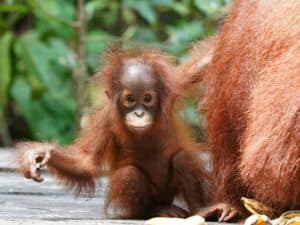
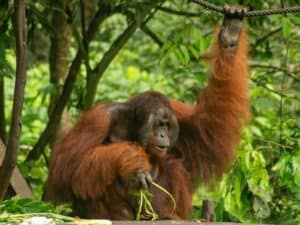
And last but far from least, the celebrities of the jungle themselves, the Bornean orangutans! These great apes are known for their distinctive reddish-brown fur and remarkable intelligence, often displaying agile tool use, exceptional memory and advanced problem-solving skills – it’s no wonder we share approximately 97% of our DNA with them!
Bornean orangutans are ‘arboreal’ creatures, meaning they spend most of their time in trees (a common pastime for monkeys), and have a fairly complex social structure: they live relatively solitary lives albeit for periods of abundant fruit, in which case they commune together in ‘parties’.
Orangutans exhibit a phenomenon called bimaturism, in which males can mature into adults in two distinct ways: they become either flanged males or unflanged males. Flanged males have prominent cheek pads called flanges and a throat sac used to make loud verbalizations called long calls, whereas unflanged males look like an adult female. To make things even weirder, an unflanged male can transform into a flanged male for reasons that are not scientifically understood!
Unfortunately, these unique creatures face threats such as habitat loss due to deforestation, illegal hunting, and the palm oil industry, the Bornean orangutan populations have declined by more than 50% over the past 60 years, and their habitat has been reduced by at least 55% over the past 20 years.
This is why booking with a sustainable tourism operator is so important – many of these extraordinarily unique primates are deeply threatened by population decline and even extinction – by booking responsibly, you actively contribute to conservation efforts and sustainable practices that help safeguard these incredible primates and their ecosystems. To find out more, visit our Responsible Tourism page to find out why, how and what we do to help!
If you would like to witness some of these incredible personalities in the flesh, check out our Borneo destination page which contains a plethora of diverse itineraries to fit all types of traveller! Alternatively, you can contact us directly, either via email (enquiries@odyssey-world.co.uk) or by giving us a call (+44 117 313 7070) to customise your own adventure!
