

SHARE:
The most bizarre (and beautiful) plants in the world!
The plants around us play an important ecological role – they convert carbon dioxide into oxygen, provide nutrients, regulate the entire climate and support life as we know it. But they also provide beauty. They are nature’s ornamentation; bestowing an otherwise barren landscape with life and vibrancy.
Humans can see more shades of green than any other colour, and it’s no coincidence. Green is the colour of grass, trees and virtually all forms of vegetation – it’s the colour of life on Earth. We see so many plants that we scarcely take notice, so when faced with a true botanical oddity, we are often spellbound by its strangeness.
In a world as large and diverse as ours, eventually, nature is going to throw some curveballs. From plants that are virtually as old as life itself, to blood-red, almost demonic parasites – nature can be beautiful, scary, eccentric and everything in between! Get ready, this blog will take you on a whirlwind journey through the enigmatic landscape of bizarre botany!

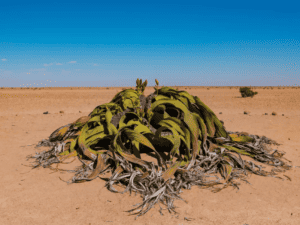
Welwitschia Mirabilis
Named after the Austrian botanist and doctor Friedrich Welwitsch, who described the plant in Angola in 1859. Welwitsch was so overwhelmed by the plant that he, “could do nothing but kneel down and gaze at it, half in fear lest a touch should prove it a figment of the imagination.”
Native to the Namib Desert, it’s often referred to as a “living fossil” due to its unusual appearance and ancient lineage. Dating back over 100 million years, with some individual plants thought to be in excess of 2,000 years old, this incredible species belongs to the gymnosperm group, which includes conifers and cycads, making it one of the oldest living plant species on Earth
Welwitschia mirabilis has only two leaves, which continue to grow throughout its lifespan, often becoming tattered and splitting into numerous strap-like segments. You may wonder how it survives in such arid climates – the truth is, we don’t really know. While it does feature a deep root system that can extend 5 feet below the ground, allowing it to access water sources unavailable to other desert plants, how it carries out photosynthesis in such harsh desert heat remains a subject of scientific inquiry.
Due to past overcollection for purposes like firewood and museum specimens, Welwitschia mirabilis is now a protected species, and it is considered endangered by some. Protecting such a species is of utmost importance, as it provides a valuable time capsule to a prehistoric Earth.
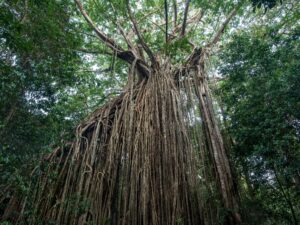
Strangler Fig
While their intricate, interwoven designs may look attractive, the Stranger Fig’s true identity is a nightmarish parasitic life form that encompasses its host tree and steals its nutrients until the original plant withers away beneath it. Nature is brutal!
Initially, a strangler fig begins as a tiny seed deposited high in the branches of a host tree by birds or other animals. As the strangler grows, its roots make their way down the tree until they begin wrapping around the host tree in a mesh-like pattern.
Like pirates of the botanical world: the strangler fig evolved these pillaging habits in order to compete in dark forests where sunlight is hard to reach and competition is harsh. Interestingly, by virtue of their strength and robustness, trees encased in these mesh lattices are more resilient to storms and cyclones, allowing them to withstand much more extreme weather conditions.
Strangler figs are also able to colonize the challenging habitat found on the sides of buildings in urban areas, and are famously present in Cambodia’s Angkor Wat – almost as if they’re serving to symbolise the degradative nature of time itself.
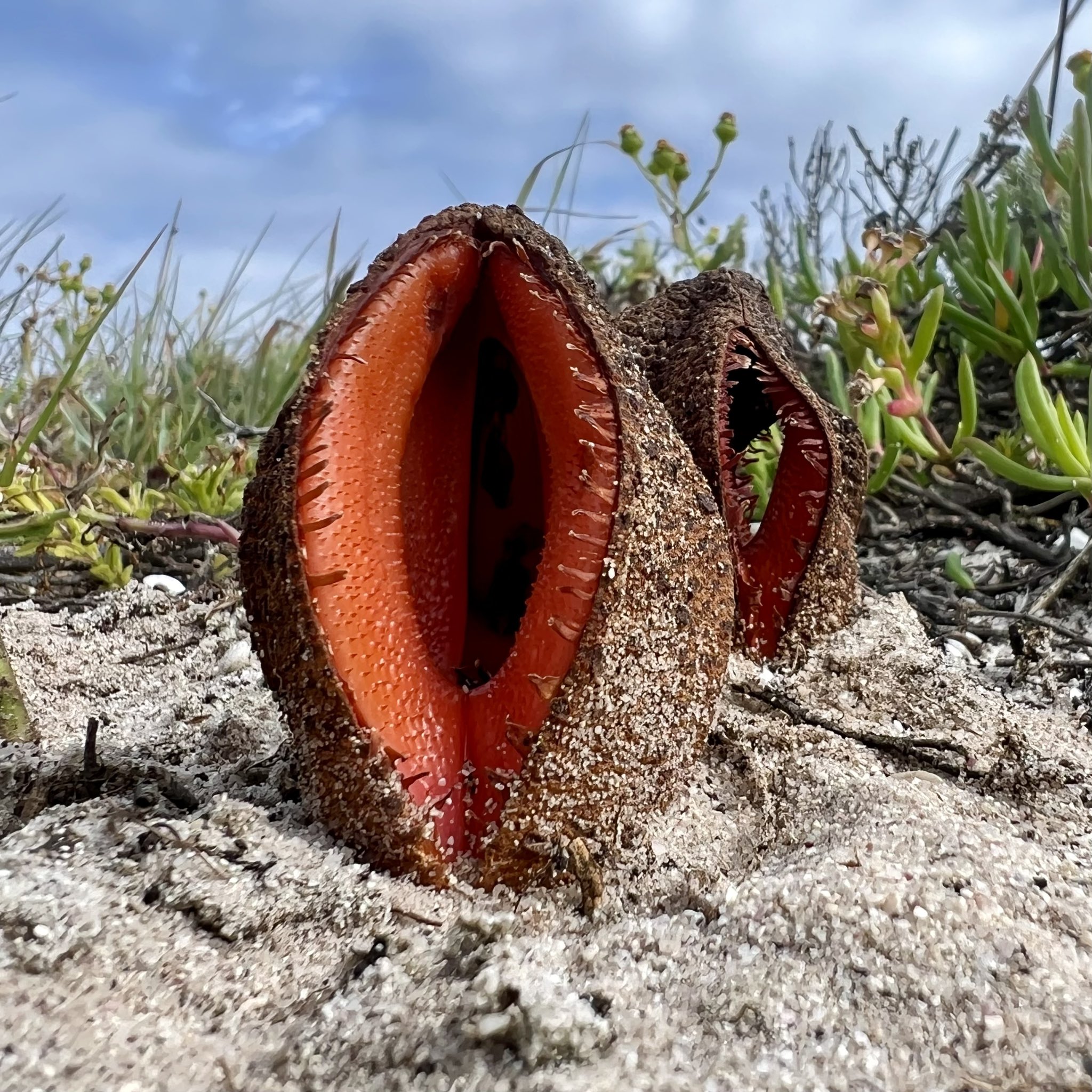
Donning the appearance of something ripped out of Stranger Things, it should come as no surprise that this plant originates from the depths of hell and is intent on world domination. Okay, not quite… this parasitic plant thrives on the roots of Euphorbiaceae (a large family of flowering plants).
Hydnora africana is unusual due to its lack of chlorophyll, which means it does not perform photosynthesis. Instead, it relies entirely on its host plants for nutrients, making it an ‘obligate parasite’.
Its vegetative parts are more akin to fungus than a typical plant, hence its demonic appearance, and the flowers serve as a temporary trap – emitting an unpleasant odour, it attracts dung and carrion beetles which become trapped within the flower, picking up pollen before being released to pollinate other flowers.
It also produces underground fruit, purportedly similar in taste and texture to potatoes. They are often consumed by nearby animals such as birds, baboons and jackals. The fruit is also used for tanning and preserving fishnets.
Rainbow Eucalyptus
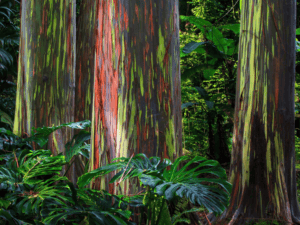
In contrast to the demonic portal, The Rainbow Eucalyptus looks more suited to an episode of Sesame Street! Scientifically known as ‘Eucalyptus deglupta’, this fascinating and beautifully coloured tree is native to the Philippines, New Guinea, and Indonesia.
As it sheds its bark, it reveals a neon green interior – over time, as it’s exposed to air, this layer ages into a variety of different colours – bright reds, oranges, blues, pinks and purples – since bark sheds at different rates, it results in a rainbow-like showcase of vibrancy.
In its native environment, the Rainbow Eucalyptus can grow up to an enormous 250 feet (76m). The thin layers of bark are also used commercially to source pulpwood, and the leaves are used to extract aromatic oil!

The Stinking Corpse Lily
A design befitting a Tim Burton film, this plant was produced by an evil witch and it sucks up the souls of all who pass it. Okay, again, my imagination gets the better of me, but the truth isn’t far from fiction…
The Stinking Corpse Lily, scientifically known as Rafflesia arnoldii (after Sir Stamford Raffles and Dr Arnold, who discovered it in the early 19th century), is a parasitic plant renowned for producing the single largest individual flower on Earth (with a diameter of over one metre)! This particular plant is secondarily known for its revolting smell!
Emitting the odour of decaying flesh (hence the name), this mechanism is designed to attract flies and other scavenging insects which act as pollinators for the unusual plant. Unlike typical plants, the Corpse Lily does not exhibit observable leaves, stems, or even roots – a very unique omission, making it purely a holoparasite – a parasite that completely relies on a host organism for all of its nutritional needs.
This demonic plant relies on the vines of the Tetrastigma genus (a perfectly respectable plant just minding its own business) for nutrients and water, embedding itself completely within and in close contact with the surrounding host cells. This parasitic lifestyle is reminiscent of fungi, allowing the plant to exploit the resources of the host organism without contributing anything in return.
Baobab Tree
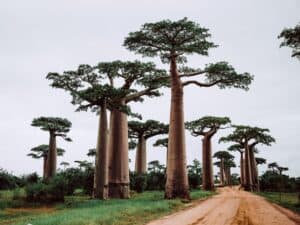
One of the most iconic and recognisable trees in the world, The Baobab tree, also known as the “tree of life” or scientifically as Adansonia, is an iconic African tree. These majestic trees, found in 32 African countries, can live up to 5,000 years, providing shelter, food, and water to both animals and humans.
Their distinctively large trunks can store water to survive in arid climates and their fruit, one of the most nutrient-dense foods globally, has gained attention for its health benefits, boasting high levels of vitamin C, antioxidants, and fibre.
Often seen as a staple of Madagascar, the Baobab tree is generally found in arid regions of Africa, including Botswana, Namibia and South Africa, as well as some parts of Australia.
If nature’s oddities appeal to you, there’s most likely a way to see them for yourself! Every plant on this list is found in a country we offer – so feel free to browse our itineraries if anything catches your eye. If you’d like to contact us directly, either email us at enquiries@odyssey-world.co.uk or call us directly (+44 117 313 7070)!
+plants+in+the+world!)